

Elegy in silk and silence. A love that never arrives
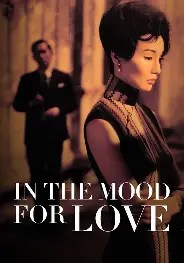
Wong Kar-wai’s In the Mood for Love is not a romance – it’s a requiem. A film of glances, gestures and gliding camera work, it tells a story of two neighbours in 1960’s Hong Kong who discover their spouses are having an affair. In their shared betrayal they form a bond and vow to never cross the line. What unfolds is a cinematic whisper, restrained, ravishing and emotionally devastating.
This is a film where longing is the protagonist, where silence speaks louder than dialogue.
Why it Still Hurts

Costuming as Armour
Maggie Cheung’s qipao’s are more than fashion – they’re emotional architecture. Each dress is a moodboard of repression, elegance and coded desire. The reputation of her wardrobe mirros the emotional restraint of her character.
Cinematography that Lingers
Christopher Doyle’s camera doesn’t just observe, it glides. Slow-motion sequences, tight hallway frames and mirrored compositions create a visual rhythm that echoes the characters emotional pacing. The film feels like a memory fragmented, stylised and suspended in time.
Dialogue as Absence
The script is sparse, but the silence is symphonic. Wong Kar-wai let’s the unsaid do the heavy lifting. Every pause, every glance, every missed opportunity becomes a line of emotional dialogue.
Time as Texture
The film is obsessed with time. It’s passing, it’s repetition, it’s emotional residue. Clocks tick, calendars flip and routines loop, but nothing truly changes. The characters remain in suspension of longing, like ghosts of their own lives.
The Ending is a Whisper
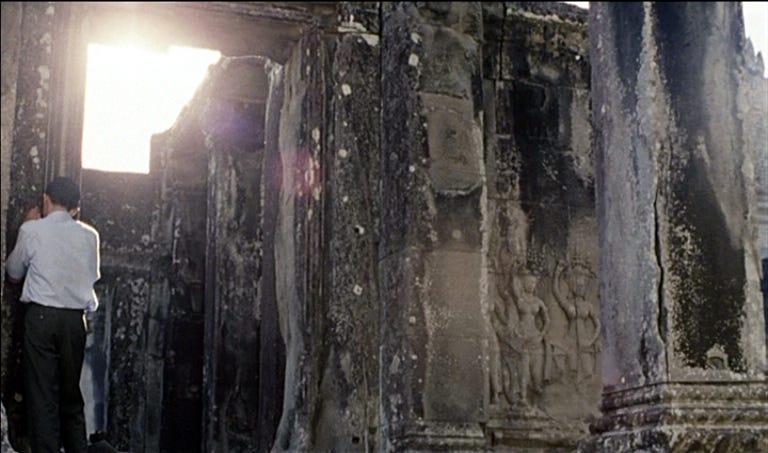
The final scenes – set in Angkor Wat – are a cinematic elegy. Chow whispers his secret into a temple wall, then walks away. It’s not closure, it’s ritual. A love that never arrived, buried in stone.
Styling Threads
- Textures: Silk, rain, wallpaper shadow.
- Palette: Crimson, mustard, charcoal, jade.
- Motifs: Hallways, clocks, noodles, doorways.
- Framing Techniques: Negative space, mirrored profiles, slow-pans, tight corridors.
In the Mood for Love is a cinematic sigh. It doesn’t chase resolution, it drifts through emotional architecture, visual poetry and the quiet devastation of restraint.
Let’s lean into longing, symmetry and the beauty of what’s left unsaid.
 Ronin Cinema