

One lie, One letter, One Lifetime of Consequences

Joe Wright’s Atonement isn’t just a period drama – it’s a cinematic elegy. Adapted from Ian McEwan’s novel, the film unfolds across decades, tracing the rippling effects of a single misinterpretation. Through war-torn landscapes, fractured timelines and the devastating power of storytelling.
This week’s trivia dives beneath the surface – into the typewriter keys, tracking shots and behind the scenes choices that shaped one of the most haunting love stories ever framed.
She didn’t just tell a story, she rewrote a life
Behind the Frame – Trivia and Insights
The Green Dress That Became Iconic

Cecilia’s (Keira Knightley) emerald gown worn in the pivotal library scene was designed Jacqueline Duuran, and was named the best film costume of all time and surpassed Audrey Hepburn’s little black dress in the film Breakfast at Tiffany’s. It became a symbol of elegance and emotional rupture.
A Million-Pound Beach Sequence
The Dunkirk evacuation scene was filmed in Redca, England, as a stand in for France. It was the most expensive set piece in the film at a cost of £1 Million. A single, unbroken tracking shot, lasting nearly five minutes, it wasn’t just technical bravado – it’s emotional immersion.
Some lies are louder than gunfire
Typewriter As Score
Composer Dario Maronelli incorporated the sound of Briony’s typewriter into the film’s score. The rhythmic clicking becomes a sonic motif for guilt, fabrication and the power of narrative control.
The typewriter didn’t just record truth, it created it
Saoirse Ronan’s Breakout Role
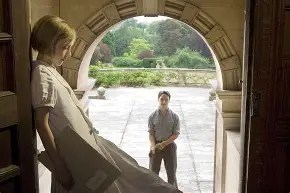
Saoirse Ronan was 13 years old when she earned her Oscar nomination for the portrayal of Briony. Her performance was eerily precise as she captured both her innocence and arrogance that fueled the film’s tragedy.
Joe Wright’s Cameo
Director Joe Wright appears briefly during the Dunkirk beach sequence – an understated nod to his immersive approach to film-making.
Atonement is a masterclass in emotional architecture. It shows hows a single moment – misread, misunderstood – can fracture lives and reshape memory.
Atonement leans into elegance, consequence and the quiet devastation of narrative power.
 Ronin Cinema